Workforce efficiency insights


What does it do?
A workforce intelligence view that brings together salary, employment percentage (FTE), time off usage, and performance data to surface patterns that wouldn't be visible in any single dataset. It identifies where high performers may be undercompensated, where workload and output are misaligned, and where teams are sustaining strong results despite (or because of) healthy time-off habits. Designed to give HR leaders a fair, business-focused picture of how investment, contribution, and wellbeing interact across the organisation.
When should it be used?
Pull this up when you need to understand whether your workforce is healthy, fairly rewarded, and sustainably structured. Most valuable during compensation reviews, promotion cycles, headcount planning, or any leadership conversation about retention risk, burnout signals, or the relationship between workload and output. Particularly useful when you want to move beyond raw performance scores and ask whether effort and reward are actually aligned.
What's inside?
- High-level efficiency insights covering performance distribution relative to salary bands, FTE, and time-off usage. Giving an immediate picture of workforce balance.
- Undercompensation signals identifying high performers whose salary sits below average or below peers at the same level, with recommended compensation or promotion actions.
- Workload and performance alignment analysis flagging employees with high FTE and above-average salary whose performance is low or declining.
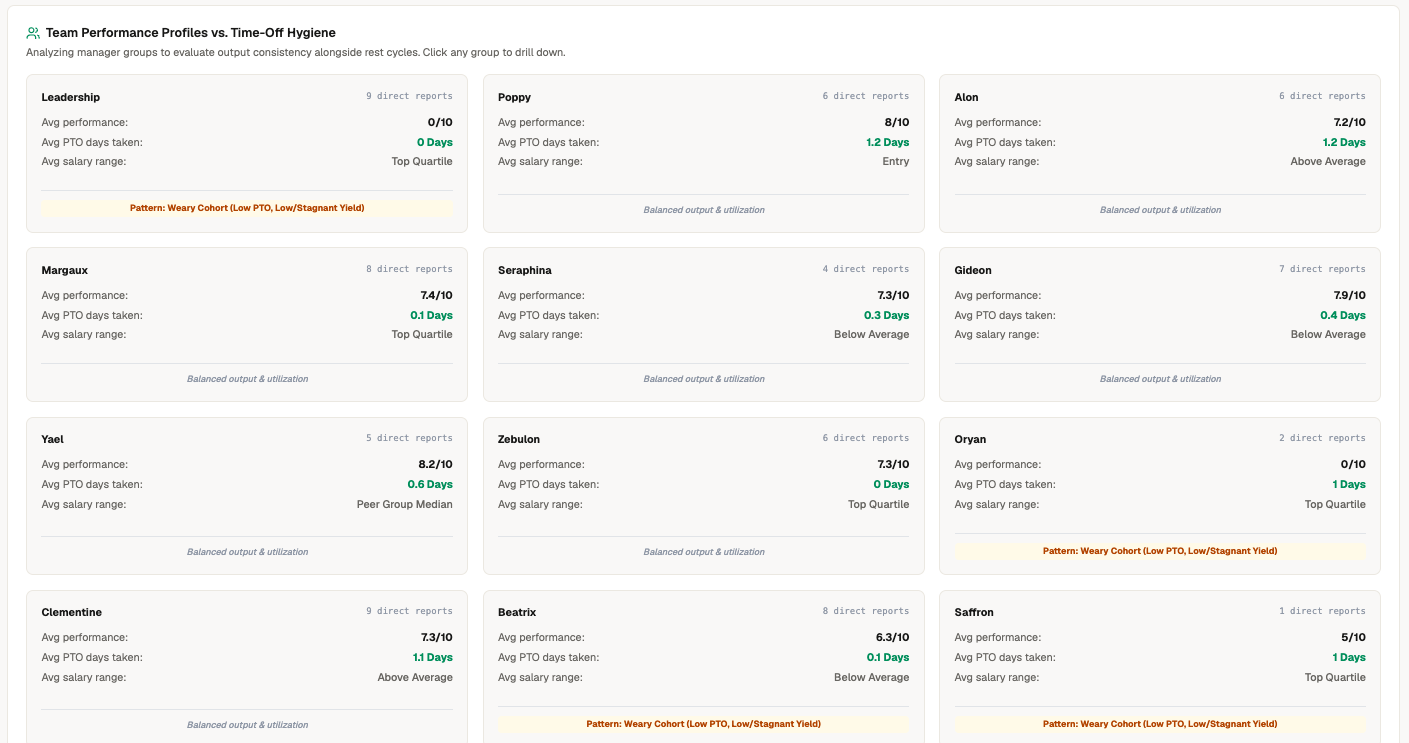
- Healthy team patterns surfacing teams that maintain strong performance alongside regular time-off usage.
- Low time-off, low return indicators highlighting where reduced time away is not translating into stronger output, signalling potential burnout or disengagement risk.
- Full-time vs part-time performance comparisons to identify contribution differences and inform FTE or resourcing decisions.
- A detailed employee-level table showing FTE, performance rating, and time away taken — enabling HR leaders to spot individual patterns and relationships between workload and results.
- Insight cards formatted for HR leaders. Each with a title, the insight, why it matters, and a recommended action, using relative language throughout rather than exposing exact figures.